•11 min read
Doom Scrolling Isn't Wasting Your Time. It's Taking Something Worse
- digital addiction
- doomscrolling
- neuroscience
- behavior change
Doom scrolling does more than burn time: it trains your brain's model of reality, narrowing what you notice and how much choice you feel.
You know the feeling. It's 1 AM, the room is dark, and your thumb is still moving. You told yourself you'd stop twenty minutes ago. You know you should sleep. You're not even enjoying what you're seeing anymore. Headlines blur together, faces you don't care about cycle past, and somewhere underneath it all is a low hum of dread that wasn't there when you picked up the phone.
You tell yourself: "I'm wasting time."
That diagnosis is wrong. What's actually happening is much worse.
You Don't See the World. You Generate It
Last night you scrolled through two hours of conflict, outrage, and catastrophe. This morning, your partner said something neutral over coffee and you heard it as a criticism. Your coworker sent a short email and you read it as hostile. The sky was clear and the day was fine, but something felt wrong and you couldn't name it.
That wasn't a mood. That was your brain running yesterday's software.
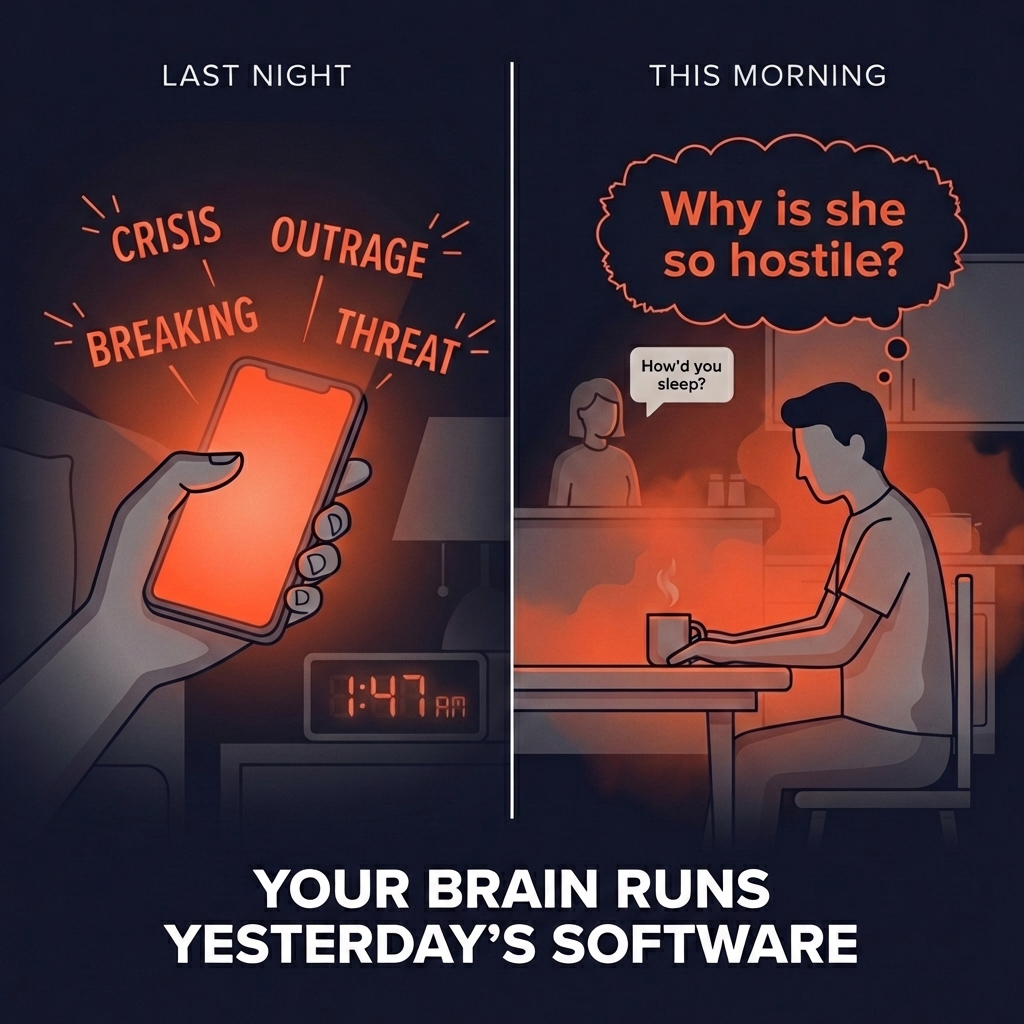
Your brain does not passively receive reality. It builds it. Neuroscience calls this predictive processing: instead of waiting for sensory input and then reacting, your brain runs a constant model of what it expects to encounter. What you experience as "seeing the world" is mostly that model projected outward. Sensory data just corrects the errors.
Cognitive scientist Mark Miller explains what's actually going on. The problem isn't bad information. It's that every scroll is teaching your brain what to expect from the world. And what your brain expects is what it builds.
Your feed becomes your belief system. Your belief system becomes your reality generator. Starve the feed, and over time, you change what you're capable of perceiving.
So when you scroll through catastrophe every night, you're not just "seeing" a dark world. You're training the model to build one. The quiet evidence of an ordinary, livable day won't register the way it should. The system has been tuned for threat.
And it's not just negative content. A feed full of aspirational lifestyles, highlight reels, and feel-good clips trains the same compulsive loop. The mechanism doesn't care whether the content is dark or bright. It cares that you keep scrolling. Any feed that holds your attention through speed, novelty, and variable reward is reshaping the model, regardless of the mood it leaves you in.
The scroll doesn't just show you a dark world. Over time, it builds one.
Why Knowing Better Doesn't Help
If you're reading this and thinking "okay, I get it, I'll just stop," this is where it gets uncomfortable.
Miller draws a sharp line between two kinds of belief. There are the beliefs you hold as a person, the things you'd say out loud if someone asked. And there are the beliefs you're not aware of, the ones running underneath, shaping how you react before conscious thought even arrives. These are not the same.
He illustrates this with the open-label placebo. Researchers give a patient a sugar pill. They tell the patient it's a sugar pill. The patient knows there's no medicine. The placebo still works. The patient's pain decreases, their symptoms improve, even though they know, consciously, that they took nothing. The system doesn't listen to what you've consciously decided. It believes whatever it was trained on.
This is why understanding that doom scrolling is harmful doesn't stop you from doing it. Your conscious self, the part reading this article, might be fully convinced. But the system underneath has been trained by thousands of hours of input. It believes what it was fed. It will keep generating cravings and pull based on that training, no matter what you've consciously "decided."
John Vervaeke, a cognitive scientist who studies attention, describes the trap precisely. You direct your attention to something and it becomes more salient. Because it's more salient, it captures your attention harder. Because you're paying more attention, it becomes more salient still. The loop spins tighter and tighter until your attention is locked and you lose the ability to notice anything else. That, Vervaeke says, is how you bullshit yourself.
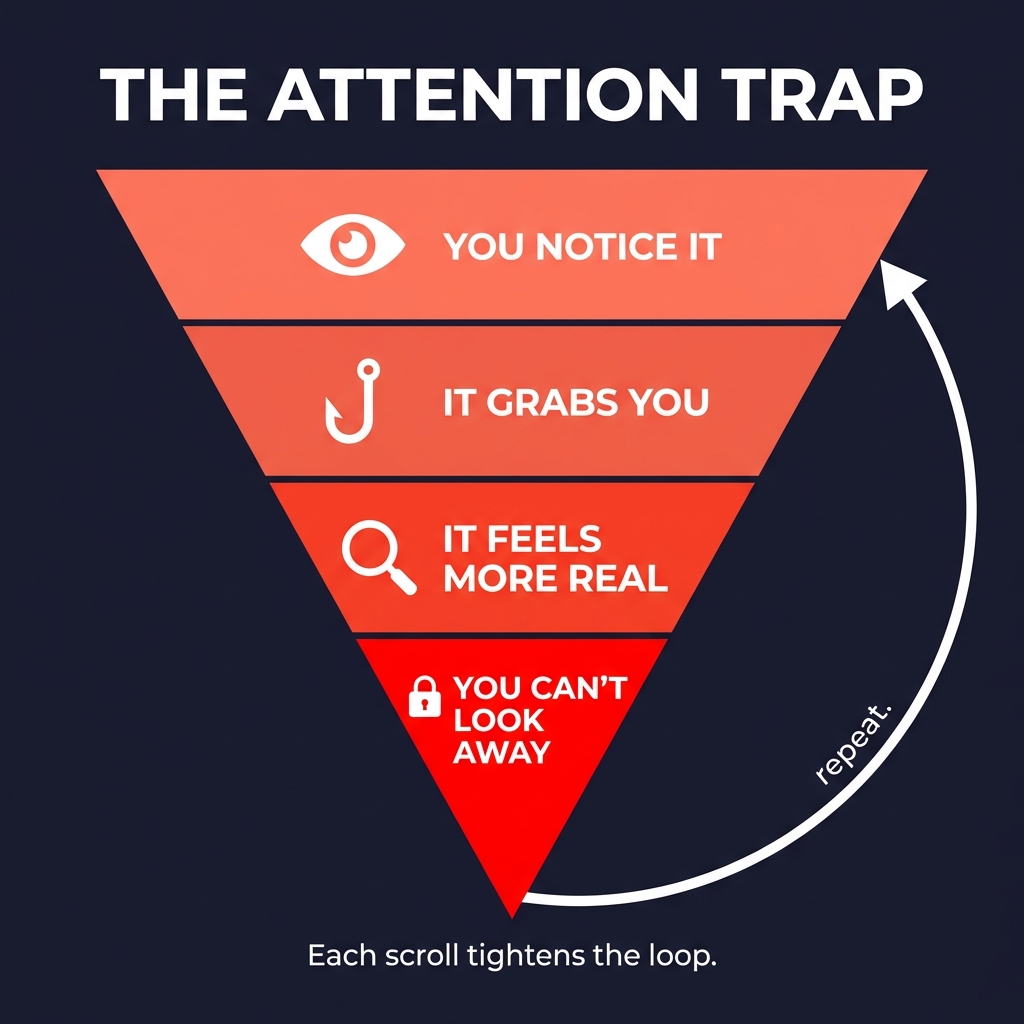
Every scroll tightens that loop. Every alarming headline becomes more "real" than the evidence of your quiet, ordinary room.
And the architecture of the trap is simple. There's some unwelcome feeling that keeps arising. Loneliness, boredom, a low-grade anxiety that never resolves. There's a behavior that temporarily distracts from it. But the behavior doesn't address the cause. So the feeling returns, and now the distraction is a little more tempting than before. And a little more. And a little more.
The Spiral You Can't Feel
The damage isn't only psychological. It's biological.
Research links internet addiction to lower levels of a protein called BDNF. You don't need to remember the name. What you need to know is that this protein is what your brain uses to change. It's the raw material of neuroplasticity, the thing that lets you learn, adapt, form new connections, and break old patterns.
When it drops, your brain loses its ability to be flexible. And then the trap closes.
Less flexibility makes it harder to break habits. Harder-to-break habits mean more consumption. More consumption drives the protein lower. Each turn of the spiral makes the next one harder to escape. Your brain is literally losing the chemical it needs to get out.
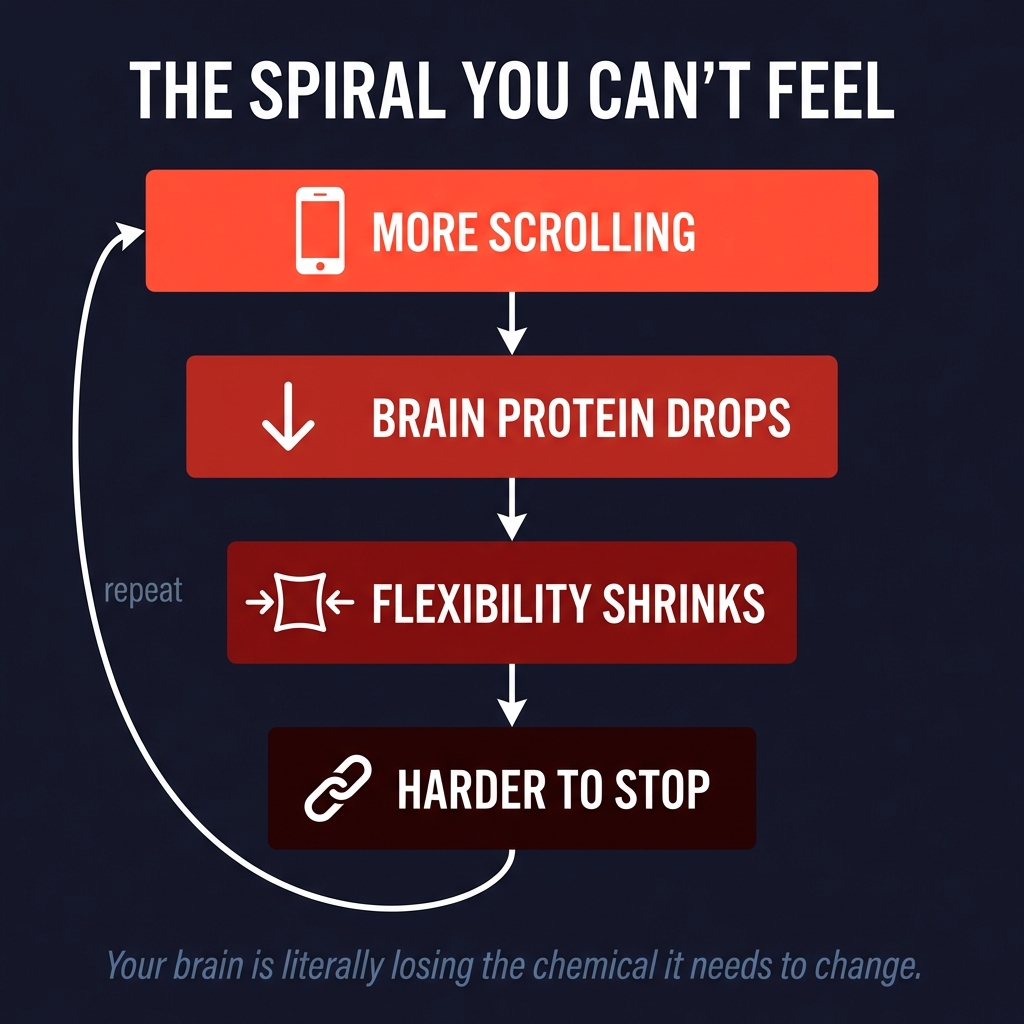
The downstream effects are blunt. You stop learning from your mistakes. You do the same thing over and over and wonder why nothing changes. Not because you're lazy. Because the biology has been compromised.
Vervaeke names the deepest version of this. As your cognitive flexibility shrinks, the number of options you can see in the world shrinks with it. As options disappear, your ability to act narrows. As your ability to act narrows, flexibility drops further. The two sides feed each other's collapse until you can't imagine being anyone else or living any other way.
That's not a metaphor for addiction. That is addiction.
You're not "losing time." You're participating in the slow-motion collapse of your own ability to choose. And the process is invisible from the inside, because the organ that would need to notice the damage is the same one being degraded.
The Rigged Table
Before you turn this into a story about personal failure, look at the other side.
None of this is accidental. Your phone is a slot machine you carry in your pocket and pay for the privilege of owning. The apps on it are engineered to be unpredictable, to amplify what grabs your attention, and to dangle the chance of going viral, all to keep your thumb moving. The same principles that make casinos addictive, applied to a device you hold every waking hour.
And there's a layer most people haven't noticed. Dr. K from HealthyGamer points out that the comments are algorithmic now too. Two people watch the exact same video and see completely different comment sections, each curated to reinforce what they already believe. One sees outrage. The other sees validation. Both walk away certain that everyone agrees with them.
It's not the introduction of new beliefs. It's the relentless confirmation of existing ones. Brainwashing by agreement.
So when you can't put the phone down at 1 AM, the problem is not your discipline. You are a human nervous system doing exactly what nervous systems do when everything around you has been engineered to grab your attention and keep it. The game was designed by people who understand your brain's weak points better than you do.
That matters. Not because it lets you off the hook, but because it tells you where the real fight is.
Interrupt the Loop
If the problem lives at the level of the nervous system, the solution has to live there too. Screen time limits and app blockers fight the behavior without touching what drives it. That's why they fail the moment your resolve dips.
Start with what's actually happening in the moment. You're scrolling because something underneath feels bad. Loneliness, boredom, a restlessness you can't name. The scroll didn't create that feeling. It just offered itself as the fastest exit. But it doesn't resolve anything. It numbs, and when the numbing wears off, the feeling is still there, plus you've added guilt and lost sleep.
The first lever is simple but uncomfortable: when the pull hits, don't fight it. Notice it. There's a difference. Fighting means gritting your teeth and white-knuckling through the craving. That's willpower, and it's already failed you. Noticing means pausing long enough to ask one question: what am I actually feeling right now?
Not "why am I scrolling." That leads to self-criticism. Just: what's the feeling underneath? Boredom? Anxiety? Loneliness? The need to feel connected to something?
Name it and you've done something the scroll never does. You've addressed the root. The feeling may not disappear. But you've broken the automatic chain from "something feels bad" to "grab the phone." That gap, even a few seconds of it, is where the loop starts to loosen.
This is the HEAL side of the trap. The unwelcome feeling that keeps sending you back to the screen doesn't need distraction. It needs acknowledgment. Sometimes that's enough. Sometimes it tells you something real: you're lonely and you need to call someone, not scroll past strangers. You're anxious and you need to slow your breathing, not speed up your input. The feeling is data. The scroll buries it. Noticing it uses it.
Retrain the Model
The moment-to-moment work buys you space. But the deeper fix is retraining the prediction machine itself.
Your brain's model of the world was built by thousands of hours of input. It won't change in a day. But it will change, because that's what it does. It's always learning. The question is what you're teaching it.
What you notice, what feels threatening, what pulls your attention, all of it depends on how your nervous system is doing. Change the state of the system, and what you see changes with it. Not through willpower. Through retraining.
In practice, this means replacing fast, shallow input with slow, complex input. Not as a wellness trend, but as a way of teaching your brain what to expect from the world. An hour of reading teaches it that reality requires patience. A real conversation, where you have to listen before you respond, teaches it that the world responds to you. Time outside, where sensory data is rich and unpredictable and nobody optimized it for engagement, teaches it that not everything is a threat.
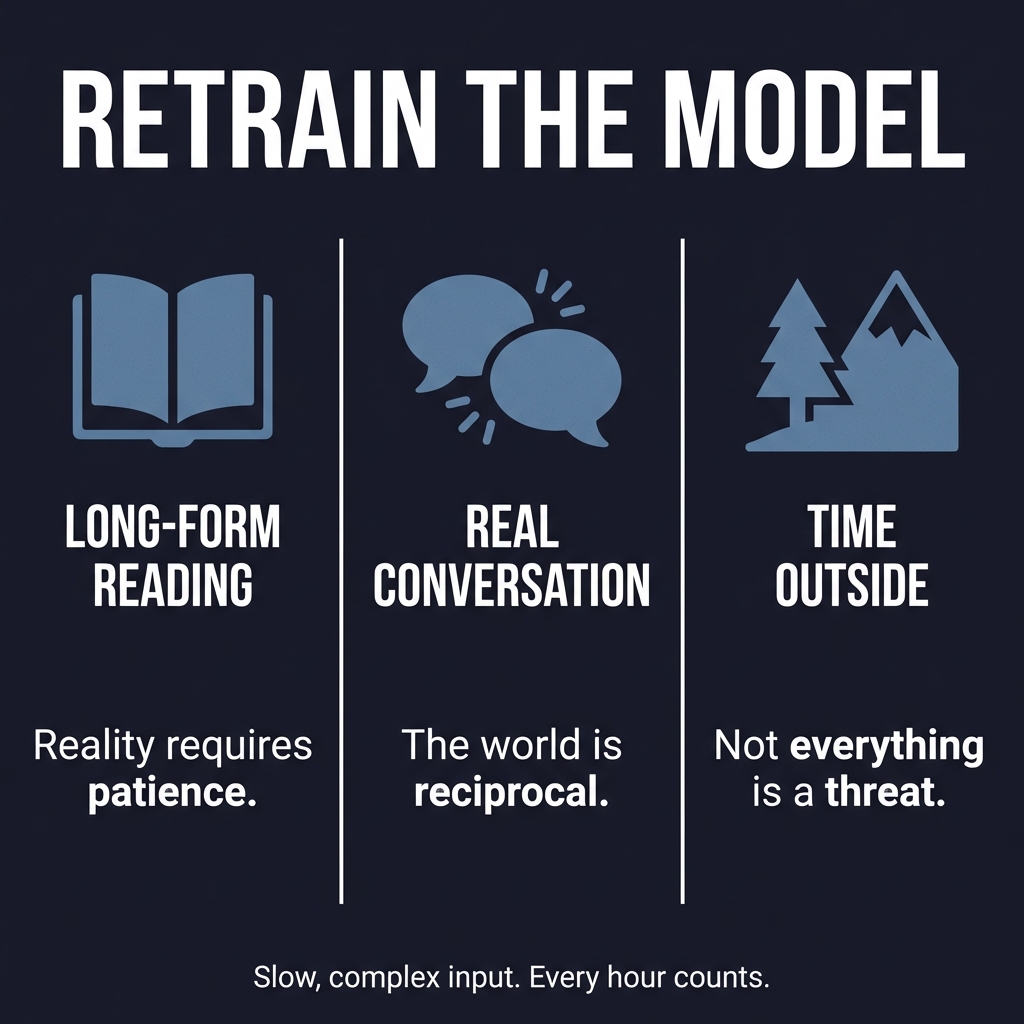
But don't rely on choosing better in the moment. The article you just read should have convinced you that in-the-moment choices are exactly what the system undermines. So change the environment. Put the phone in another room before bed. Turn the screen to grayscale so the colors can't pull you. Remove the apps that own the most hours of your attention. Make the scroll harder to start, not harder to stop. These aren't life hacks. They're structural interventions that match the structural nature of the problem. If the system's inputs are rigged, change the inputs at the design level.
You're not doing these things because someone told you screens are bad. You're doing them because every hour of slow, complex input is an hour where the model recalibrates toward a world that is richer and less hostile than the one the scroll builds.
And be patient with the process. The early days will feel impossibly hard. Not because you're weak. Because the biology is temporarily working against you. The spiral that locked you in will take time to reverse.
Here's what to watch for: the first signs are small. You'll catch yourself reaching for the phone and pausing, just for a second, before picking it up. You'll notice a sunset that last week you would have walked past. A conversation will hold your attention a little longer than it used to. These aren't dramatic. But they're the model updating. They're your brain learning that the world is wider than the feed suggested.
Knowing that it gets easier, knowing the system can recalibrate, is not a solution. But it's a reason to keep going when the pull is strongest.
The brain's model is always learning. Right now, at 1 AM, with your face lit by the screen, it's learning that the world is a stream of emergencies, outrages, and strangers performing their lives for your consumption.
Put the phone down, and it starts learning something else.
Sources: Mark Miller (predictive processing), John Vervaeke (Awakening from the Meaning Crisis), Dr. K / HealthyGamer (BDNF and internet addiction), Judson Brewer (The Craving Mind), Peter Wang, Marc Lewis (The Biology of Desire), Brian Maierhofer. For deeper reading: Andy Clark, Surfing Uncertainty (2015); Maia Szalavitz, Unbroken Brain (2016).